
What the AI is for
The workspace AI is slower than asking a chatbot the same question. It maps topics before it researches, researches before it writes, and cites as it goes. Each step has a reason, and knowing them makes the module easier to use.
It is not there to save you the writing. It is there to make the reasoning behind a decision inspectable by someone who was not in the room.
Why not just ask a chatbot
Section titled “Why not just ask a chatbot”“Which search provider should we use” is answerable in one paragraph by any model. Six months later that paragraph is useless, because nobody can tell which parts were established, which were assumed, and what was never considered.
The workspace answers a second question instead: how do you know? The rest of its design follows from that.
Research: one narrow topic, one asset
Section titled “Research: one narrow topic, one asset”Given a request, the AI does not start answering. It states its method — map the topics first, research each separately, then plan the content from what they find — and registers the topics as a list you can see before the expensive work begins.
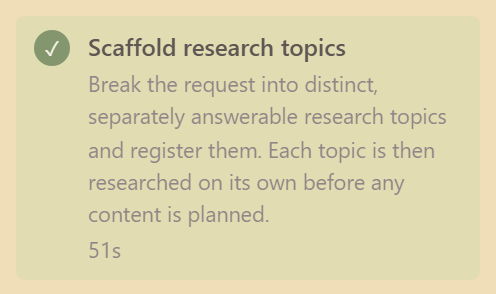
Each topic then becomes exactly one research asset, and the plan text is explicit that a topic must not be widened to cover the others in the register.
The constraint is what makes the evidence usable. One sprawling “search provider research” note cannot be checked, reused, or partly rejected. Twelve narrow ones can: you can trust the pricing work, distrust the performance work, and record both.
It also gives you an early exit. The registered topics appear before any research runs, so a misread question shows up in seconds instead of ten minutes later.
Sourcing: real URLs, or a labelled gap
Section titled “Sourcing: real URLs, or a labelled gap”The plan is equally explicit about where evidence may come from. It passes only real page URLs — ones a search returned or you supplied, never invented — and where a topic has no URLs at all, the run answers from the model’s own knowledge and saves the result as clearly labelled uncited findings.
A model asked a question will always produce an answer. What matters is whether you can tell the sourced answers from the unsourced ones, and here you can, in three places: the Sources used count on each step, the links under each finding, and the labelling of uncited work.
Your standing AI instructions sharpen it further. Told to flag any claim it cannot source, the AI carried the instruction all the way into the finished document as an in-line warning.

Gaps are output, not failure
Section titled “Gaps are output, not failure”The panel reports “Research completed with evidence gaps” instead of presenting a partial answer as a whole one.
Every research process has gaps, and most reporting hides them, because prose has no natural way to say “we could not establish this”. A declared gap on a criterion you care about is a task with a name.
Content: planned against the evidence, not written from memory
Section titled “Content: planned against the evidence, not written from memory”When the AI writes, it plans the document in named sections and grounds each one in specific research it has already gathered — not in what the model happens to know about search providers.
The finished item then carries a Generated from N sources badge, so a reader can go from a sentence to the research to the source without asking anyone.
The chain only holds because the research came first. Content written straight from a prompt has nothing to point at, and shows no badge.
Staging: additive by default, destructive by permission
Section titled “Staging: additive by default, destructive by permission”Auto-apply creates new content without asking but holds edits to existing content until you approve them.
The asymmetry is deliberate. Creating something costs you a delete; overwriting something can destroy work a person did by hand. The AI is trusted with the reversible half.
It handles duplicates the same way: asked to create a scratchpad of open questions when one already existed, it linked to the existing one instead of making a second.
What it is deliberately not doing
Section titled “What it is deliberately not doing”It is not deciding. It gathers evidence for a question. Whether the question is the right question, and which way the evidence points, stays with you.
It is not reading everything. It selects the references relevant to each topic, so adding a document does not guarantee it is used. If a specific source must be read, say so in the request.
It is not filling its own gaps. It reports what it could not establish and stops there.
It is not private. Transcripts are visible to workspace members, because the reasoning is meant to stay with the decision.
What this means for how you ask
Section titled “What this means for how you ask”Two habits get much better results out of this design.
Ask for the end product, and name the specifics. “Compare search providers” gives the AI nothing to decompose. Naming three candidates and three criteria gives it a register of topics worth researching.
Put your standards in the workspace instructions, not in chat. Instructions apply to every future run; a correction applies to one reply. Constrain source quality, force a comparable unit, and demand that unsourced claims be flagged, and the whole chain improves at once.
Related
Section titled “Related”Control what the AI does covers the settings. AI panel reference names every control. Evidence and provenance follows the chain from source to published sentence.