
Services troubleshooting
Most service-level confusion comes from three things: content belonging to one service only, membership covering the whole service, and Content Access being a ceiling rather than a default. These are roughly in the order they come up.
I cannot find something I made
Section titled “I cannot find something I made”It is in a different service. Everything belongs to exactly one, and there is no shared pool.
Check the other services you have access to. If you are certain it was made here, check whether the module it lives in has been switched off in Service Settings → Modules. The content is still there; the module is just hidden.
A module has disappeared from the sidebar
Section titled “A module has disappeared from the sidebar”Someone turned it off in Service Settings → Modules.
Nothing was deleted. Turning it back on restores it with its content.
I turned a module off and want to be sure nothing was lost
Section titled “I turned a module off and want to be sure nothing was lost”Nothing was. The toggle controls whether the module appears, not whether its content exists. Turn it back on and everything is as it was.
Someone can see a module I did not expect
Section titled “Someone can see a module I did not expect”Membership is service-wide. Anyone in the service can reach every module switched on in it, and there is no per-module permission.
If two groups should see different things, they need two services. Module toggles will not achieve it — they change what is shown, not who may reach it.
I set Content Access to “anyone signed in” and nothing changed
Section titled “I set Content Access to “anyone signed in” and nothing changed”That is correct. Content Access is a maximum, not a default.
It sets the widest audience an item is allowed to choose. It does not publish anything, and it does not widen items that are already published. Each item still picks its own audience.
I tightened Content Access but something is still visible
Section titled “I tightened Content Access but something is still visible”The new ceiling already applies to items published before you changed it. An item set wider than the ceiling is treated as if it were set to the ceiling.
Two things can still reach people outside it. Anyone with an active share link can open an item, regardless of its access level, so revoke the links you no longer want. Copies on external publishers follow External publishing instead, and narrowing it unpublishes existing content from publishers the service no longer allows.
Something is published and nobody knows why
Section titled “Something is published and nobody knows why”There is no single list of published items in a service. Open the modules the service uses and check each published item’s sharing settings, which show who can open it and any active share links.
The artifact map looks almost empty
Section titled “The artifact map looks almost empty”It draws connected artifacts. A service full of content that nothing references produces a sparse map.
Read the note in the corner of the map: it states how many assets are not shown because nothing references them yet. That number is usually the answer.
An artifact is missing from the map
Section titled “An artifact is missing from the map”Three reasons, all stated on the map itself. Nothing references it yet, it is a task counted on its board rather than drawn individually, or it is a resource with no project allocation.
The map shows relationships, so something with no relationships has nothing to draw.
The asset library shows more items than the artifact map
Section titled “The asset library shows more items than the artifact map”They answer different questions. The library lists everything; the map draws only what is connected to something else.
The map states the gap in its corner — how many assets are not shown because nothing references them yet. Artifacts and assets explains the three views and why their counts differ.
I cannot find an Add Service button
Section titled “I cannot find an Add Service button”Creating services is a platform-level action rather than something every service member can do. Ask whoever administers the platform.
An asset appeared in the library that I did not upload
Section titled “An asset appeared in the library that I did not upload”That is expected. The library catalogues everything the service creates — charts, dashboards, data views, task boards, projects, email templates — not just uploaded files.
You do not add things to the library. Making them anywhere in the service puts them there.
The metadata panel never finishes loading
Section titled “The metadata panel never finishes loading”Opening Metadata in the Asset Library shows “Loading…” and stays there.
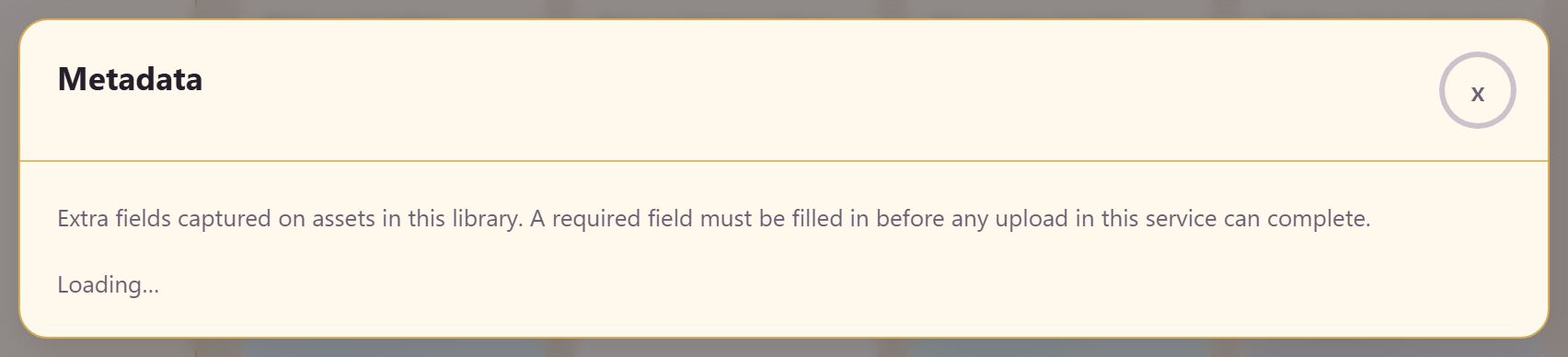
The request behind it succeeds — the server returns the field list correctly — but the panel re-requests it in a loop instead of rendering. Measured on the version tested for this documentation, that was roughly 150 requests per second for as long as the dialog stayed open.
Close the dialog. Leaving it open puts steady load on the server for no benefit. Custom metadata fields already defined still work: required fields are enforced when an upload is processed, whatever the editor is doing.
This has been reported.
I duplicated a service and my content is missing
Section titled “I duplicated a service and my content is missing”Duplicate copies the configuration, not the content. That is deliberate — it is a way to stand up a new service shaped like an existing one, not a way to copy work.
The audit log shows a change nobody made
Section titled “The audit log shows a change nobody made”Filter by actor type. Scheduled jobs, AI agents, and the system all appear in the log, and the human filter separates them from people.
A change that happened overnight with nobody working is usually a scheduled job behaving exactly as configured.
I cannot add a data connection even though I am a member
Section titled “I cannot add a data connection even though I am a member”Data Hub is the exception to the usual service roles. Creating a data source needs a platform-level admin role, not just service membership; linking a source that already exists does not.
Data Hub permissions has the detail.