
Evidence and provenance
A workspace tracks where everything came from at three points: when you choose a reference, when the AI records a finding, and when content is generated. Each one answers a different question.
At the reference: is this worth reading?
Section titled “At the reference: is this worth reading?”The asset picker rates every candidate on six signals before you add it.
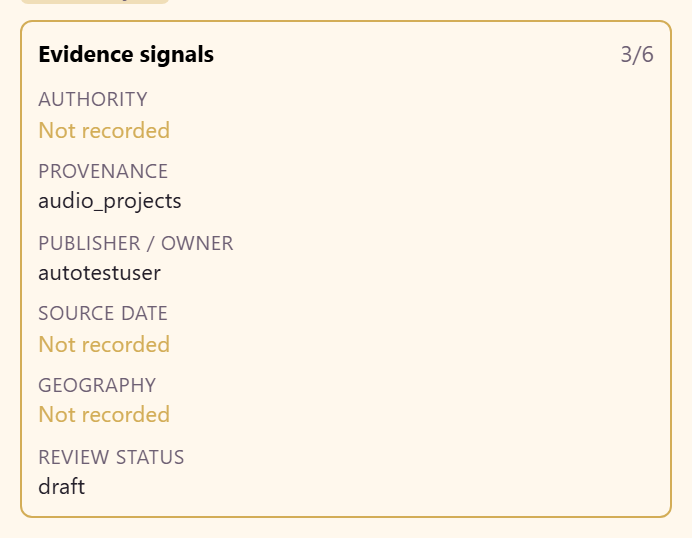
Authority, provenance, publisher or owner, source date, geography, and review status — with a count of how many are filled in.
The picker states the reason: choose evidence by these signals, not title alone. A document called “Search Provider Comparison” could be a vendor’s marketing page or last quarter’s internal analysis, and only the signals tell you which.
These live on the asset in the Asset Library, not in the workspace, so filling them in helps every workspace that touches the material.
At the finding: how do you know?
Section titled “At the finding: how do you know?”A research item is a question, a summary, findings, and the sources under each finding. The sources are the part that makes it checkable.
Every step in the AI panel carries a Sources used count, so a conclusion resting on one source is visibly different from one resting on four — which prose alone will never tell you, because both read as equally confident.
The workspace also records what it could not establish. “Research completed with evidence gaps” states the limits of the evidence, which a smooth answer covering the same ground would not.
At the content: what was this written from?
Section titled “At the content: what was this written from?”Generated content carries a Generated from N sources badge.
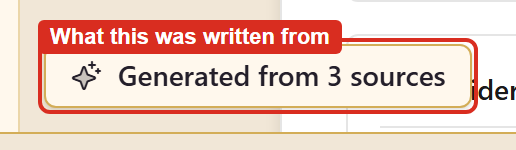
The badge is what lets a reader go from a sentence in a published document back to the research behind it, and from there to the source. Content typed by hand has no badge, because there is nothing to point at.
Linked from runs the other way — what points at this item — which matters when you are about to rename or remove something.
Why the chain matters
Section titled “Why the chain matters”Six months after a decision, three things get questioned: the conclusion, the numbers, and whether anyone considered the obvious alternative.
Without a chain, all three mean redoing the work. With one, the conclusion points at findings, the findings point at sources, and the rejected alternatives are still in the Research rail with their evidence intact.
This is what the module is for. A workspace is slower than writing the document directly, and what you get for the time is the ability to answer “how do you know?” without starting again.
Where it stops
Section titled “Where it stops”The chain records where a claim came from, not whether the claim is true. A finding can cite three sources and still misread all three.
It also cannot tell you whether the question was the right one. A perfectly evidenced answer to the wrong question is still the wrong answer, and nothing in the provenance chain will flag it.
Both stay human work. The workspace only makes checking quick enough to be worth doing.
Related
Section titled “Related”What the AI is for explains how the chain gets built. Gather references covers choosing source material.