
How a workspace is organised
A workspace has three rails down its left side, and everything in it sits in exactly one of them. The separation is not filing. It distinguishes what you were given, what you established, and what you are claiming.
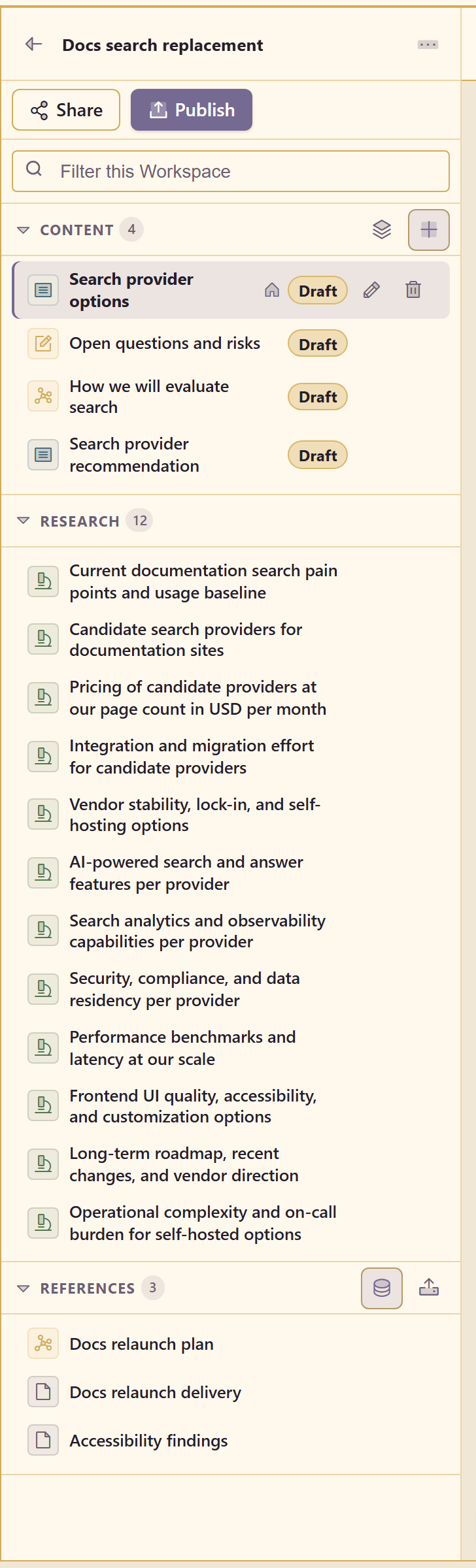
A single filter box above them searches all three at once.
References — what you were given
Section titled “References — what you were given”Source material. Files you upload, or assets linked in from the service’s Asset Library.
References are inputs. Nobody wrote them for this decision, and the workspace does not treat them as answers.
The AI selects which references are relevant to a given question rather than reading everything every time, which is why a workspace can hold more source material than any one question needs.
Research — what you found out
Section titled “Research — what you found out”What the AI established from those references and its own searching, pinned as a structured item.
Every research item has the same shape: the question it set out to answer, a status, a summary, findings, and the sources behind them.
The fixed shape is what makes research checkable. An item is not a note; it is a claim with its evidence attached.
Research is also where evidence gaps live. The AI reports when a topic completed with gaps instead of presenting a partial answer as a whole one.
Content — what you are claiming
Section titled “Content — what you are claiming”Documents, charts, and scratchpads: the things you would show someone, and the only rail that gets published.
Content is written from research, and generated content records what it was made from. That provenance is what lets a reader trace a sentence in a published document back to the source it came from.
Why not just write the document
Section titled “Why not just write the document”You could skip the middle rail and write straight into Content. Workspaces exist because that loses two things.
The evidence stops being checkable. A document that says “Algolia costs more” is an assertion. A document written from a research item that cites Algolia’s pricing page is a claim you can verify without redoing the work.
The gaps stop being visible. Research records what it could not establish. A finished document rarely does, because prose smooths over uncertainty. Six months later nobody can tell which parts were solid.
The direction of travel
Section titled “The direction of travel”References feed research; research feeds content. Create from research is the button that moves something along, and it is the path that carries the provenance with it.
Nothing stops you writing content by hand, and for a short note that is fine. Hand-written content simply carries no provenance badge, because there is nothing for it to point at.
Where the rails leak, deliberately
Section titled “Where the rails leak, deliberately”The rails are not sealed. Research items and scratchpads are registered as assets in the service, which means they show up in the asset picker as Workspace Research and Workspace Scratchpad.
So one workspace’s research can become another workspace’s reference. This is the intended route, and it runs through the Asset Library by design: the evidence picks up metadata and a review status on the way.
What belongs in one workspace
Section titled “What belongs in one workspace”One question. A workspace is scoped to a decision, and its purpose statement is what the AI uses to judge relevance.
Two unrelated questions in one workspace means the purpose has to cover both, which makes it vague, which makes the research worse. Two workspaces is the answer.
Related
Section titled “Related”Run a decision end to end puts this into practice. Evidence and provenance follows the chain from source to published sentence.